

My partner Sam and I spent four months being more deliberate about eye cream than I ever expected to be. I had been meaning to test the under-$30 category properly since a dermatologist told me, without much fanfare, that the eye area starts losing collagen density in your early 30s and that consistent use of even a basic moisturizing eye cream delays the compounding effects. That felt like useful information. So Sam and I picked five options, assigned one to each of us per month, swapped notes, and tracked what happened. CeraVe Eye Repair Cream, ASIN B00JJPMXDO, was the fourth product in our rotation and the one neither of us wanted to put back when the month ended. That is how it became the permanent shelf option.
What I want to do here is not just review CeraVe in isolation. I want to tell you what the comparison actually revealed, because the tradeoffs you notice when you are switching between products on a set schedule are different from the observations you make when you stick to one thing for months. You start to notice what a product does not do only when you go back to something that does it differently.
The Quick Verdict
The most consistently tolerable eye cream in a field of five. Not the fastest or the flashiest, but the one that works for two people with different skin types, never causes irritation, and layers cleanly under everything we put on after it.
Amazon Check Today's Price →Tired of trying eye creams that either sting, pill, or cause bumps? Here's what four months of comparison testing came down to.
CeraVe Eye Repair Cream with hyaluronic acid, niacinamide, and ceramides. Fragrance-free, ophthalmologist-tested, and the one we kept coming back to across a five-product comparison.
Amazon Check Today's Price on Amazon →The Comparison Setup and What We Were Testing
The five products in our rotation were all purchased on Amazon, all priced under $30, and all marketed for puffiness, dark circles, or fine lines. I am not naming the others by brand because the point is not to trash competitors but to use the comparison to explain what makes CeraVe different in practice. Sam has combination skin with a tendency toward morning puffiness that takes about 40 minutes to clear without any intervention. My skin type is dry with more of a dark-circle issue than a puffiness issue, so we were testing for two different primary concerns simultaneously.
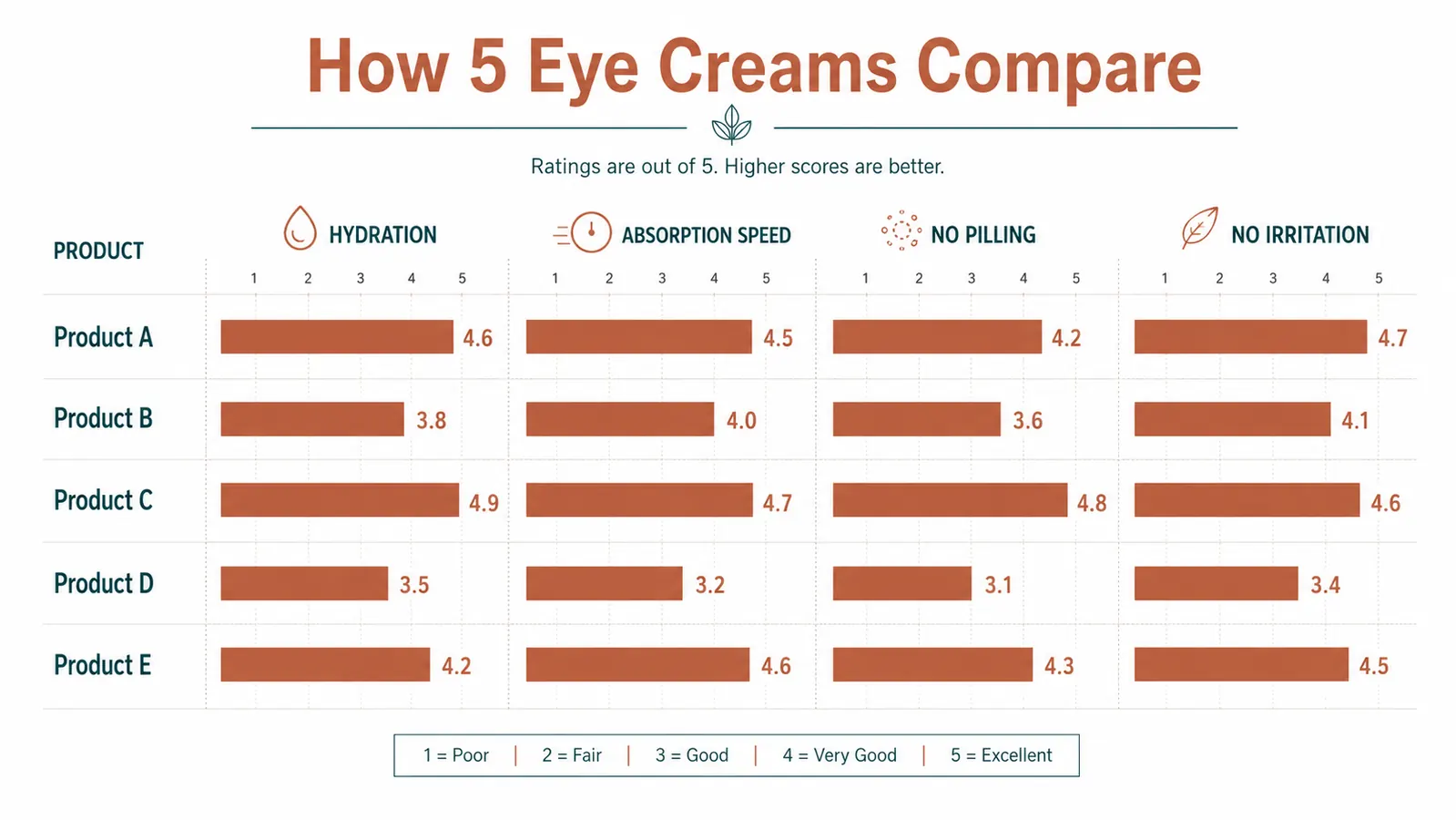
We rated each cream on four things after every two-week stint: how well it hydrated through the day, how fast it absorbed, whether it pilled under concealer or SPF, and whether it caused any milia or irritation. The first product caused milia on Sam's outer eye corner by week two, which ended that trial early. The second had a faint floral scent that was pleasant in the jar and unbearable by the time it was near Sam's eyes first thing in the morning. The third absorbed beautifully but pilled so aggressively under my SPF that I had little white flakes in my under-eye crease by 10 a.m. The fourth was CeraVe. The fifth we tested afterward just to confirm our conclusion, and it confirmed it.
The comparison framing matters because it explains why I am not giving CeraVe a perfect score. It does not do everything the best of the group did individually. But it is the only one that did nothing wrong across all four criteria for both of us simultaneously. That is a rarer quality than it sounds.
What the Ingredient List Actually Tells You
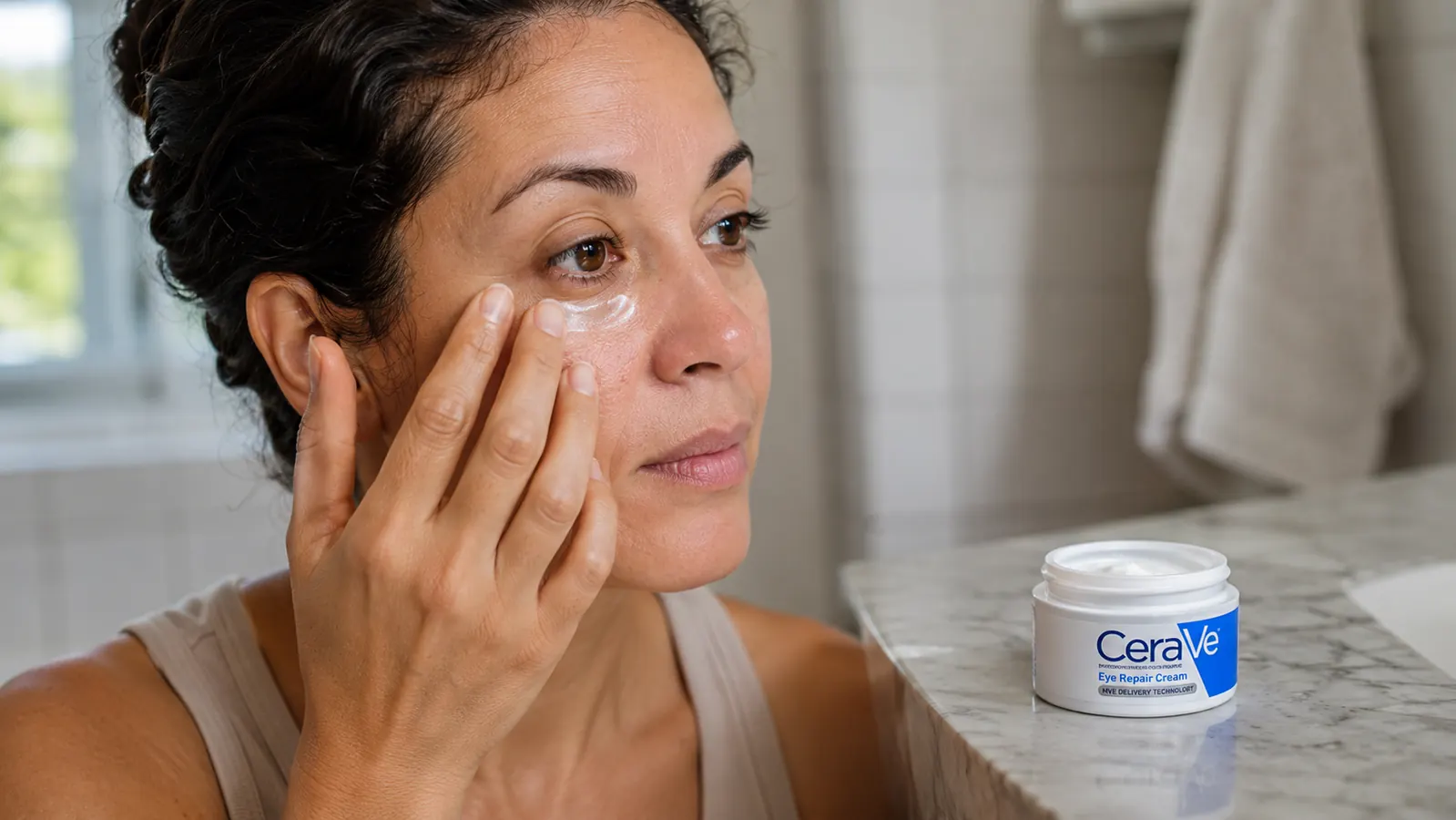
CeraVe Eye Repair Cream leads with hyaluronic acid, niacinamide, and a ceramide complex (ceramides 1, 3, and 6-II). Hyaluronic acid is a humectant, pulling water into the outer layers of skin from both the environment and deeper tissue. For the eye area specifically, which has thinner skin and fewer oil glands than the rest of the face, this matters more than it does elsewhere on the face. Thin skin loses moisture faster, and the loss shows as crepiness and fine lines earlier than it would on, say, the cheek.
Niacinamide (vitamin B3) is where a lot of the brightness benefit comes from. It has published evidence for improving uneven skin tone and reducing surface hyperpigmentation over 8 to 12 weeks of consistent use. For brown-toned dark circles that have a pigmentary component rather than a purely vascular one, niacinamide is doing real work here. For the blue-toned circles caused by visible blood vessels in thin skin, niacinamide helps somewhat by brightening the surface but does not address the underlying cause. That distinction is important, and I'll come back to it.
The ceramide complex is what separates CeraVe from most products at this price tier. Ceramides are lipid molecules that form part of the skin barrier and decline naturally with age. When the barrier is compromised, transepidermal water loss increases, the under-eye area looks dull and hollow, and fine lines deepen. Topical ceramides replenish those lipids gradually over weeks of consistent use. You do not feel ceramides working the way you feel a hyaluronic acid serum plumping your skin in 20 minutes. They operate quietly and their benefit compounds over time. That is one of the things nobody tells you.
What Nobody Tells You About This Cream
The first thing nobody tells you is that this cream absorbs unevenly depending on skin temperature. On cold mornings, when your face is still cool from washing, it sits on the surface slightly longer than it does in summer or after a warm shower. That is not a defect. It is how most ceramide-heavy creams behave. But if you apply it immediately before SPF or concealer on a cold morning and do not wait 90 seconds, it will interact with the next layer. Give it that 90 seconds and the layering problem disappears entirely. Of the five creams in our comparison, this was the only one where timing fixed the pilling issue completely.
Of the five creams we tested, CeraVe was the only one where a simple 90-second wait fixed every layering issue. That sounds minor. After three months, it does not feel minor.
The second thing nobody tells you is that the jar is genuinely a problem for hygiene-conscious users, and that the workaround is so simple it barely counts as an inconvenience. A small skincare spatula, the kind that comes with many jars or costs nothing to buy separately, eliminates the contamination concern entirely. I have been using one since month one and the cream looks and feels exactly the same as it did when we opened it. Sam still uses his finger and has had no issues in four months, so I acknowledge this may be overcautious. But near the eyes, I prefer overcautious.
The third thing: dark circles are one of the most over-promised categories in skincare, and this product is honest about its limits in a way that most of its competitors are not. The formula does not contain retinol, peptides, or vitamin C. Those are the ingredients that drive faster visible change but also carry the highest irritation risk near the eyes. CeraVe is built for tolerance and consistency, not for speed. If you have prominent dark circles and you want them to look better in two weeks, you will be disappointed by this and by virtually every other topical product on the market. If you have under-eyes that look tired, crepey, and puffy, and you want them to look consistently better over several months of use, this will deliver.
Sam's Experience: Puffiness-First Perspective
Sam's primary concern going into this comparison was morning puffiness. The under-eye area swells overnight in people with certain fluid retention patterns, and it is more visible in people with thinner, lighter skin. Sam's skin is medium-tone, combination, and he wakes up with noticeably puffy lower lids most mornings, especially after late nights or anything involving salty food. He is also someone who had never used an eye cream before this test and was fairly skeptical about the category.
By week three of the CeraVe stint, Sam noted that his puffiness was clearing faster than it had been. Not eliminating during sleep, but clearing more quickly after waking. He attributed this partly to the habit itself, since tapping a cool cream near the eye has a mild mechanical depuffing effect, and partly to what he described as 'the skin feeling less stretched and irritated' in the morning. By the time we moved to product five at the end of month four, Sam had already bought a replacement jar of CeraVe and was back on it within a week. That is a fairly clear signal.
How It Compares to the Other Four in Practice
Across all four criteria, here is the honest summary. Hydration: CeraVe was not the most immediately hydrating. Product three delivered a noticeable plumping effect faster, but it also caused pilling and felt slightly occlusive by midday. CeraVe's hydration is more even and sustained through the day without any heaviness. Absorption: CeraVe is middle of the pack. With the 90-second wait it layers perfectly. Without it, it needs more time than the lightweight gels in our test but less time than the heaviest emulsion.
No pilling: CeraVe wins cleanly here among the jar-format products, as long as you follow the absorption time. The lightweight gel option also did not pill, but it had almost no active ingredient density, so it did not do much else either. No milia or irritation: CeraVe is the only product of the five that caused zero irritation events for both of us across the full testing period. The milia from product one lingered for six weeks after we stopped using it. The fragrance reaction from product two cleared in 48 hours but was unpleasant. CeraVe was completely uneventful, which in the eye-cream category is genuinely the highest compliment.
What I Liked
- Zero irritation events across four months for two people with different skin types and concerns
- Layers cleanly under SPF and concealer with a brief 90-second absorption window
- Ceramide complex delivers genuine barrier benefit that accumulates quietly over weeks
- Fragrance-free and ophthalmologist-tested, essential for any product applied this close to the lash line
- Works on both puffiness (via consistent hydration and barrier support) and surface brightness (via niacinamide)
- Sam's morning puffiness cleared noticeably faster by week three, despite no prior eye cream use
Where It Falls Short
- Jar packaging is the least hygienic format for a product used twice daily near the eyes; use a spatula
- No retinol or peptides means this will not outperform active-ingredient options on deep wrinkles or crow's feet
- Structural or vascular dark circles will not improve, no topical product addresses those root causes
- Absorption takes roughly 90 seconds in cooler conditions; rushing the next step causes minor pilling
- The immediately plumping effect is more subtle than gel formulas, which may disappoint anyone who wants instant visual feedback

Who This Is For
CeraVe Eye Repair Cream is for anyone who has already been burned by an eye cream, whether that means milia, stinging, fragrance reactions, or pilling under their SPF. It is for people who want one product that works for both partners in a shared bathroom without requiring different routines or skin type negotiations. It is for anyone who is willing to be patient with their under-eye area and wants a fragrance-free, ophthalmologist-tested cream that builds results over weeks rather than promising overnight transformation. Sam and I both fit those descriptions, which is probably why it is still on the shelf.
It also works particularly well if you are new to eye creams and do not want your first experience to be an irritation event. The formula is gentle enough that if you apply slightly too much or use the wrong finger, nothing bad happens. That tolerance for user error is underrated in a product category where the skin is this thin and sensitive. See our full long-term test at the CeraVe Eye Repair Cream long-term review if you want the week-by-week scoring data.
Who Should Skip It
Skip CeraVe Eye Repair Cream if you want measurable results on deep wrinkles in a short timeframe. A retinol-formulated eye product will outperform it on collagen stimulation and fine-line reduction, though it will also require tolerance building and will cause some dryness or peeling during that adjustment period. If you have committed to a comprehensive anti-aging protocol and you have already built retinol tolerance on the rest of your face, you may want to look at an eye-specific retinol or a peptide-forward formula. CeraVe's value is its safety profile and its ceramide foundation, not its speed.
Also skip it if the jar format bothers you on principle. There are tube-format options with similar ingredient profiles. For some people the hygiene concern about jar packaging near the eyes is a dealbreaker regardless of the spatula workaround, and that is a completely reasonable position. If that is you, look for the same active ingredients (hyaluronic acid, niacinamide, ceramides) in a pump or squeeze-tube format. You will pay more. But the format preference is real. For more on what to look for across eye cream options in this category, see our breakdown of 10 reasons eye cream is worth the step.
Five eye creams. Four months. One winner. Here's where to check today's price on the one that lasted.
CeraVe Eye Repair Cream with hyaluronic acid, niacinamide, and essential ceramides. Fragrance-free, ophthalmologist-tested, works for both skin types in our shared cabinet.
Amazon Check Today's Price on Amazon →