

Every morning for about two years, I pressed my index finger directly into the tissue under my eyes and wondered why nothing was improving. The puffiness after a bad night's sleep, the faint circles that makeup never fully covered, the crepe-y texture that seemed to arrive overnight sometime around my mid-thirties. I had eye cream. I was using it. It just was not working. When I finally paid attention to how I was applying it, and when, and in what order, the results were noticeably different within three weeks. Technique turns out to matter more than product.
My partner started following the same routine after watching the difference on my end. Neither of us has sensitive skin, but the orbital bone area is genuinely thinner and more reactive than the rest of the face for anyone. The steps below reflect what actually moved the needle for both of us over about four months of consistent morning and evening use with CeraVe Eye Repair Cream, which is the one we kept reaching for after testing a few alternatives.
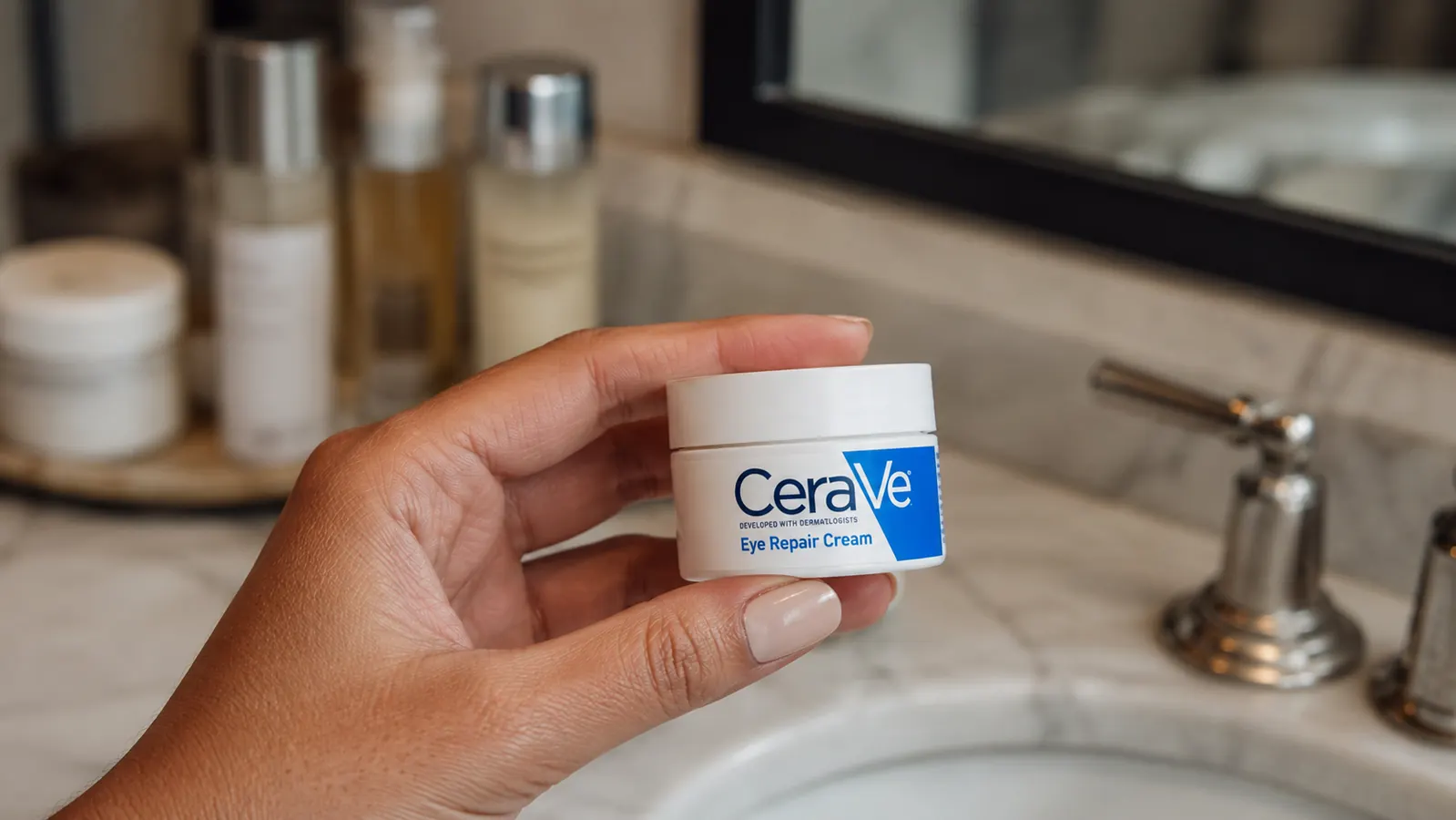
Puffy under-eyes that a night of sleep never fixes? This is the exact cream we use in this routine.
CeraVe Eye Repair Cream contains hyaluronic acid, niacinamide, and three ceramides. It works for both men and women, and it holds up as well at step five of a full routine as it does used alone. Check current availability on Amazon.
Amazon Check Today's Price on Amazon →Step 1: Start With a Clean Face, Not Just a Rinsed One
Eye cream goes on after cleanser, and that order matters for a reason that has nothing to do with the eye area specifically. Sunscreen residue, makeup, and overnight sebum all sit on the surface of skin and act as a partial barrier to any active ingredients you apply on top. If you are using eye cream on a face that was rinsed but not actually cleansed, you are applying it over a film. I used a gentle foaming cleanser in the morning, my partner preferred a cream cleanser, and we both noticed eye cream absorbed more smoothly immediately after switching from a quick rinse to a proper cleanse.
Pat dry rather than rubbing, especially around the orbital bone. The skin there is thin enough that aggressive towel friction adds mechanical stress over time. A clean, damp face is fine, and some formulas including CeraVe Eye Repair Cream actually absorb better into slightly damp skin because hyaluronic acid draws moisture into the tissue rather than from it.
Step 2: Dispense the Right Amount (Less Than You Think)
The under-eye zone from lash line to top of cheekbone covers roughly one square centimeter per side. The amount of product that area can actually absorb in a single application is tiny. For CeraVe Eye Repair Cream, I use a dot about the size of a small green pea per eye. My partner uses slightly less because his skin tends to run oilier under the eyes than mine. If you press the product on and it takes more than 45 seconds to absorb, you have probably applied too much. Excess product on this area often migrates into the eye itself, which can cause minor irritation and does nothing extra for puffiness.
Dispense product onto the ring finger of each hand, not directly under the eye. The ring finger is the weakest of your four main fingers, which is exactly why it is the recommended tool for this area. The pressure you apply unconsciously with your index finger is too much for tissue this thin. Using your ring finger builds the habit of a light touch even when you are tired or rushing.
Step 3: Tap Along the Orbital Bone, Not Directly on the Skin Under the Eye
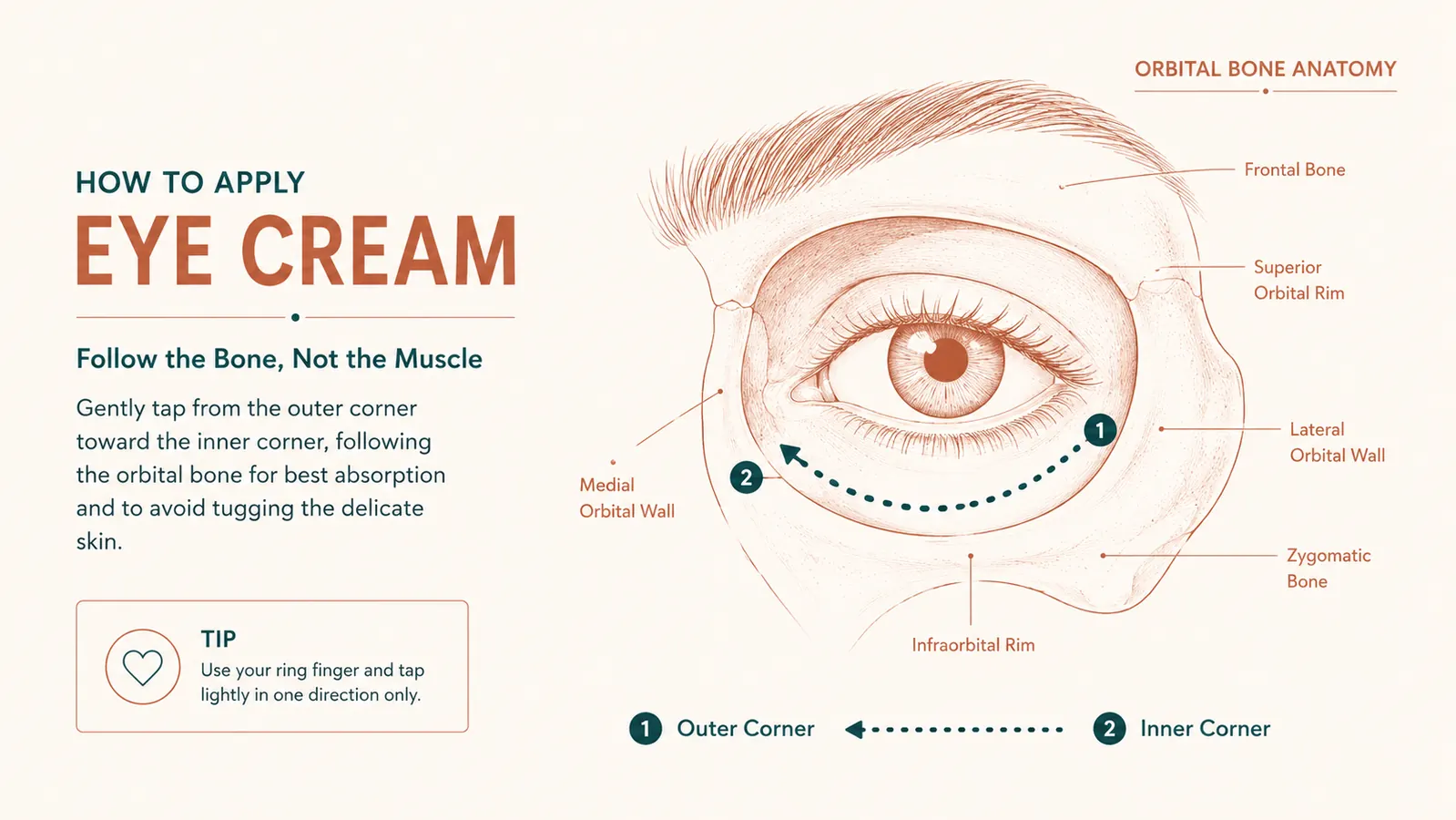
This is the step most people skip because nobody explains why it exists. The orbital bone is the bony ridge that circles your eye socket. You can feel it by pressing gently around the eye. Eye cream applied directly to the most delicate skin right below the lash line, or directly on the visible puffed area, is more likely to cause irritation and less likely to absorb evenly. Tapping along the orbital bone, working from the outer corner inward toward the nose, lets the product migrate naturally to the correct areas without the pressure concentrating on one spot.
Use the ring finger to tap in a half-circle from just below the outer corner of the eye, under the eye, around to just inside the inner corner. Do not drag. Do not rub. Small, quick taps about half a centimeter apart. On the upper lid, tap from the inner corner outward toward the temple. The full circuit takes about 15 seconds per eye when done correctly. I know that sounds slow, but it becomes automatic within a few days.
Step 4: Let It Set Before Layering Anything On Top
One of the reasons people decide eye cream does not work is that they layer moisturizer, sunscreen, or concealer on top before the eye cream has set. The under-eye area needs about 60 to 90 seconds to absorb a cream formula. During that time, the hyaluronic acid in CeraVe Eye Repair Cream is drawing water into the tissue, and the niacinamide is beginning to do its work on the uneven pigment that creates the appearance of dark circles. If you apply a moisturizer on top while the eye cream is still wet, the two formulas blend at the surface and neither absorbs properly.
My morning routine goes: cleanse, tone, vitamin C serum, then a 90-second wait before eye cream, then moisturizer. At night I apply eye cream after my actives have absorbed and before any overnight oil. The specific order matters less than the waiting. What you want to avoid is stacking wet product on wet product in the first 60 seconds after application.
The difference was not the product. I had been using a decent eye cream for over a year. The difference was applying it to the orbital bone, tapping instead of rubbing, and giving it 90 seconds before layering moisturizer on top.
Step 5: Refrigerate the Cream for Morning Puffiness
Cold constricts blood vessels and reduces lymphatic fluid accumulation, which is most of what we call morning under-eye puffiness. Most people elevate their head during sleep but still wake up with some swelling because of overnight fluid pooling. Keeping your eye cream in a small refrigerator, or even just the bottom shelf of a regular bathroom cabinet in a cool room, gives you a cold compress and active ingredients at the same time. My partner started keeping CeraVe Eye Repair Cream in the bathroom cabinet we keep near the window, which stays about ten degrees cooler than the rest of the room in the morning, and that small change visibly reduced his morning puffiness within two weeks.
If you do not have a skincare fridge and do not want one, you can get a similar benefit by lightly pressing a cold spoon under each eye for 15 seconds before applying the cream. Both approaches work by the same mechanism. The key is doing it before application, not after, so the cream absorbs into tissue that has already had initial depuffing from the cold.
What Else Helps
Consistency with application matters more than anything else on this list. I tracked my own results and my partner's over four months, and the weeks where we skipped mornings showed notably less cumulative improvement than the weeks where we applied both morning and night without gaps. CeraVe Eye Repair Cream is stable enough for twice-daily use because it does not contain retinol or high-strength acids. That makes it easier to build a streak around.
Hydration and sodium intake genuinely affect under-eye puffiness in ways that topical products cannot fully compensate for. If you are drinking enough water and limiting high-sodium meals the night before, your morning puffiness baseline is lower and eye cream has less to work against. This is not a cosmetic tip, it is physiology. The under-eye skin is the first place many people show systemic dehydration or inflammation. Addressing both the topical routine and the hydration habits at the same time accelerates visible results.
SPF is the other lever. UV exposure degrades collagen around the eye area faster than anywhere else on the face because the skin there is so thin. A mineral SPF 30 or higher applied gently over the orbital bone each morning protects the results you are building with eye cream. My partner resisted this step for about six weeks and then added it after noticing that my crow's feet area was improving faster than his. He now uses a tinted SPF 30 over the orbital bone on mornings when he does not wear any other product.
If dark circles are your primary concern rather than puffiness, niacinamide is your friend. CeraVe Eye Repair Cream contains it, which is one reason we chose it over other drugstore options. Niacinamide inhibits melanin transfer to surface skin cells, which gradually evens out the discoloration that reads as dark circles. It works slowly, over a period of six to twelve weeks, not overnight. We saw the most obvious improvement in weeks seven through ten of consistent use.

The ceramides in the formula deserve a mention too. The under-eye area has a compromised moisture barrier in almost everyone who has been in cold or dry air, used aggressive makeup removers, or simply aged past thirty-five. Ceramides replenish the lipids that make up that barrier. Once the barrier is more intact, active ingredients in the same product absorb better and the area becomes less reactive to environmental irritants. That combination of barrier support and actives is the main reason CeraVe Eye Repair Cream outlasted the other three formulas we tested over this period.
Ready to build the routine? CeraVe Eye Repair Cream is the one product we kept in our shared cabinet after testing four alternatives.
It handles puffiness, dark circles, and fine lines with a fragrance-free, twice-daily formula that works for both partners regardless of skin type. See the current price and availability on Amazon.
Amazon Check Today's Price on Amazon →