

Let me tell you what happens when you search for Mielle Rosemary Oil reviews: you get before-and-after videos with dramatic music, comment sections full of 'omg this changed everything,' and a collective certainty that this small bottle of mint-scented oil will fix whatever is happening on your head. I get why people feel that way. I felt a version of it too. But after months of real use, watching my partner and I both cycle through expectations and results, I want to give you the review I wish I had found before buying.
The short version: Mielle Organics Rosemary & Mint Scalp & Hair Strengthening Oil is a genuinely good scalp product. It is also misunderstood at a category level, overpromised on social platforms, and completely wrong for a subset of people who are buying it based on viral content. This article is about understanding exactly where it lands, so you are not disappointed if you are in the wrong bucket, and not missing out if you are in the right one.
The Quick Verdict
A solid scalp oil with real active ingredients, but the viral version of this product is a different product than the real one. Understand what it actually does before you buy.
Amazon Check Today's Price →If your scalp is the issue, this is a good place to start.
Mielle Organics Rosemary & Mint Scalp & Hair Strengthening Oil with Biotin is consistently available on Amazon. Read this review first so you know what to expect, then check today's price.
Amazon Check Today's Price on Amazon →How I Came to This Review
I am a beauty editor. That means I have a professional relationship with skepticism. When a product goes viral, my instinct is to wait for the wave to pass and then evaluate what actually remains. The Mielle Rosemary Oil wave was significant enough that it got a proper assessment on our end, not a rushed first impression.
My partner Dani and I have been using it for several months now, but unlike a structured clinical diary, this article is more about pattern-matching across what actually happened versus what we expected to happen based on what we had seen online. Dani has thick, naturally wavy hair with a tendency toward a dry scalp. I have fine hair with color damage history and a hairline I have been keeping a watchful eye on since my late twenties. Our experiences with this oil were different enough that I want to address both, because I think the person buying this product on a wave of social media enthusiasm is often one specific hair type, and that matters.
I also read a meaningful chunk of the negative reviews on Amazon before writing this. Not to cherry-pick disappointments, but because the pattern of complaints teaches you something about what the product actually is versus what buyers expected.
What Mielle Rosemary Oil Actually Does
The ingredient list tells the story honestly, even if TikTok does not. Rosemary oil is the headliner, and it has real published research behind it. A study in the journal Skinmed compared rosemary oil to 2% minoxidil (the active in Rogaine) for androgenetic alopecia over six months and found comparable hair count increases. That is a meaningful data point. But here is what that data point does not tell you: the rosemary oil in that study was applied at a standardized concentration, twice daily, for six full months. Most people using Mielle Rosemary Oil are not doing that.
Peppermint oil is also in the formula, and the research on it is similarly real: a 2014 animal study found that peppermint oil application caused better hair growth outcomes than minoxidil, with an increase in follicle depth and dermal papilla size. Again, real mechanism. Again, context matters. The concentration and application frequency in these studies is not necessarily replicated by a twice-weekly scalp treatment that most of us fit in between regular wash days.
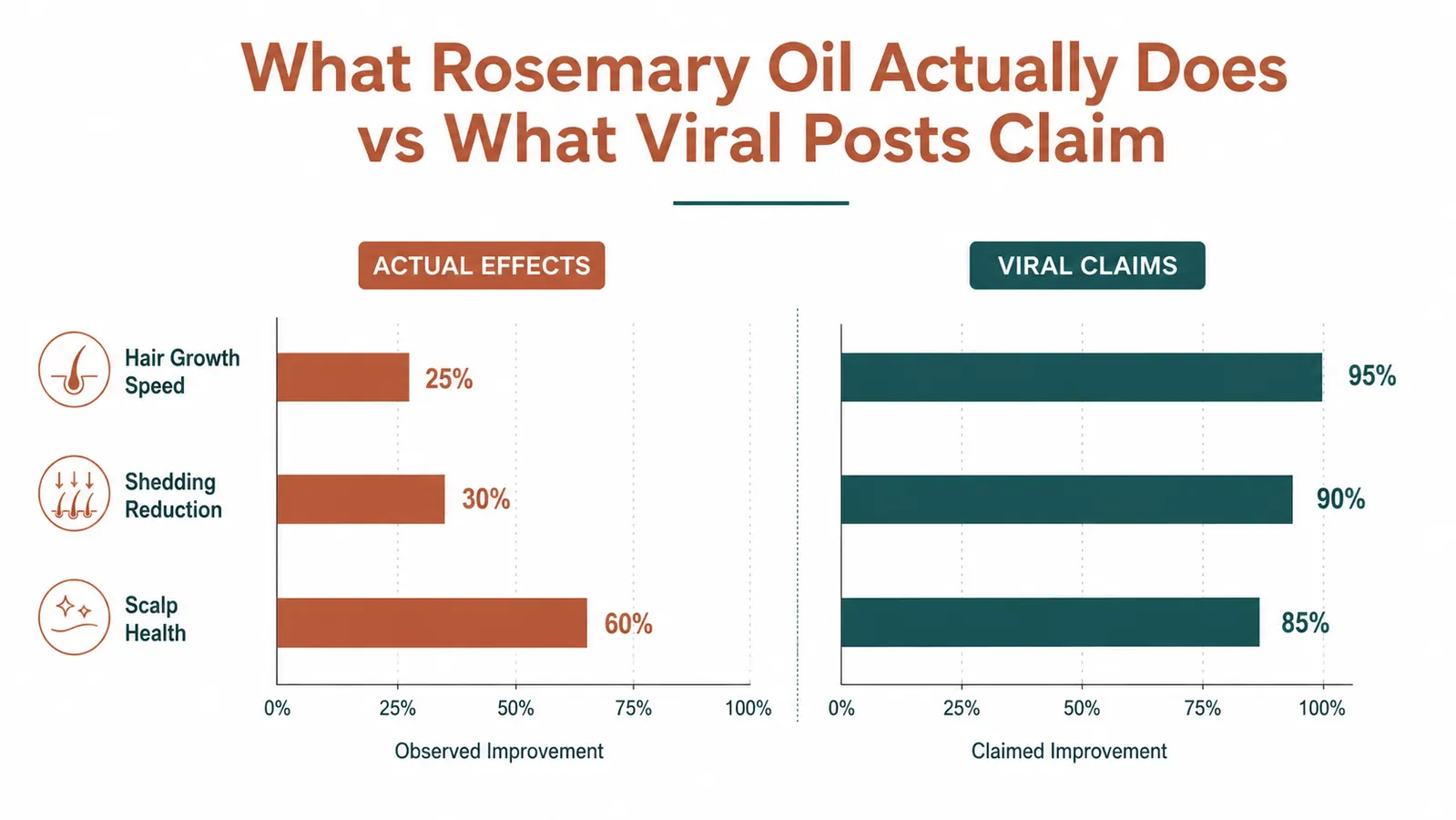
What Mielle Rosemary Oil genuinely does well: it improves scalp circulation at application, reduces flakiness and dryness, and supports the scalp environment in which healthier hair can grow. Biotin included topically is less proven in terms of absorption than oral biotin, but the babassu and jojoba oils in the base formula are good scalp conditioners. This is a real product doing real things. The exaggeration is in what those things mean for your hair length and density timeline.
The Hype vs the Reality: What Nobody Tells You
Social media hair content has a structural problem: it rewards dramatic before-and-afters and penalizes nuanced timelines. The person who sees inches of new growth in a month is going to make a video. The person who sees a gradual reduction in shedding over three months is going to journal about it privately, if at all. This creates a perception problem where the outlier result looks like the average result.
The person who buys Mielle expecting to regrow a bald patch in 30 days is a different buyer than the person who wants to support a healthier scalp environment. Only one of those buyers will be satisfied.
Here is what the negative review pattern on Amazon tells you: the disappointed buyers are almost uniformly people who expected accelerated regrowth and did not get it. 'Used it for six weeks and saw nothing.' 'Did not grow my edges back.' 'Stopped after two months because my hair was the same.' These people were not using the product incorrectly. They were using a reasonable product for an unreasonable expectation. Edges that have been thinned from years of tension hairstyles or hormonal changes need more than a topical oil. And six weeks is barely month two in a product that works on a follicle timeline.
Dani got results that matched the right expectations. Her dry scalp improved noticeably within the first month. Flakiness that she had attributed to her shampoo turned out to be a scalp hydration issue, and consistent oil applications addressed it more effectively than switching products had. She also noticed less breakage during detangling by around week eight. None of that is the dramatic regrowth story. All of it is genuinely valuable if you were having those problems.
The Texture and Application Experience
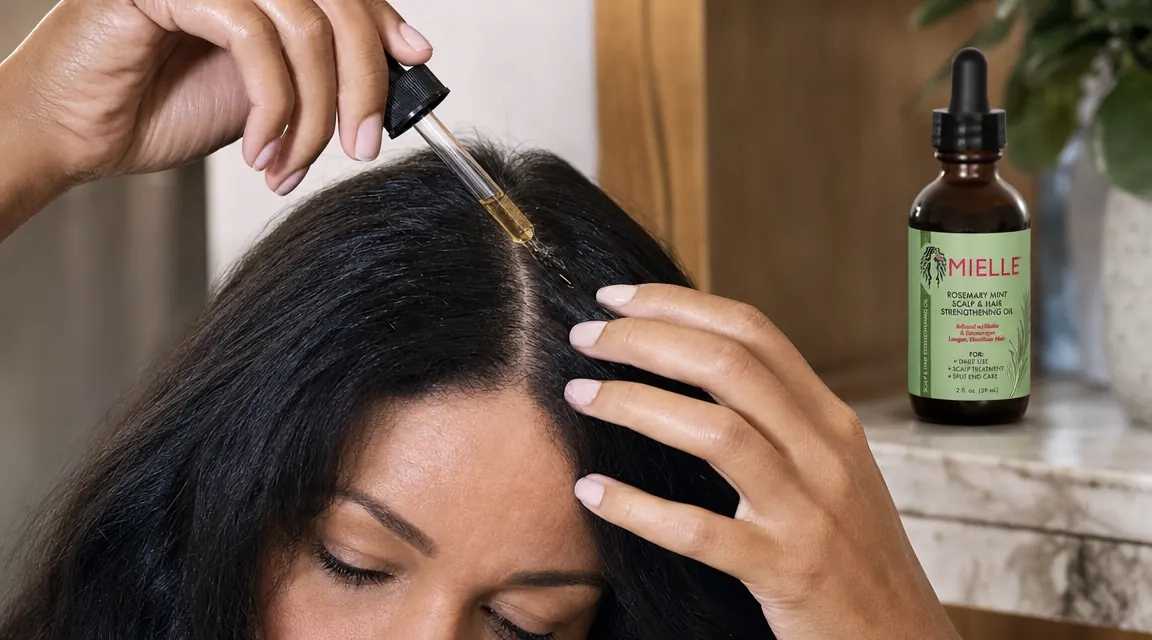
The oil is lighter than it looks in the bottle. Amber and opaque, it reads like something thick, but it applies more like a medium-weight oil, not like castor oil or a heavy conditioning treatment. The mint scent arrives immediately and is strong for about 15 to 20 minutes before settling. If you have never used a peppermint-forward scalp oil, the tingling sensation is real and intentional. It means the menthol is activating. If your scalp is dry or sensitized, that tingle can read as mild irritation at first. Give it two or three applications before deciding whether you tolerate it.
The dropper applicator is precise enough for targeted scalp work on straight or wavy hair but slow for dense natural hair that needs coverage across multiple parts. For fine or straight hair types, the dropper is actually one of the better delivery mechanisms for scalp work because it deposits product where you want it without flooding the mid-lengths. For thicker textures, a bottle with a nozzle tip would be more practical. This is an applicator designed for one hair type family being sold to all hair type families.
One thing I appreciate: the formula does not build up. Some scalp oils leave a residue that compounds over applications and starts gunking up your scalp by week two. Mielle does not do that, at least not at twice-weekly use. Your regular shampoo cycle removes it cleanly. That cleanability matters for scalp health, since product buildup can itself contribute to follicle congestion.
The Tradeoffs Worth Knowing Before You Buy
The bottle is 2 fluid ounces. That is a small container for a product that works on a months-long timeline. If you are the only person using it and you apply conservatively, you might stretch a bottle to eight or ten weeks. If you have thick or long hair, or if you are sharing it with someone, budget for more frequent repurchasing. This is not a flaw in the formula but it is a cost-of-use consideration that the viral content never mentions. The per-ounce price is reasonable; the bottle size means the per-period cost is higher than it looks at purchase.
The mint scent is not universally loved. Dani found it pleasant. My previous partner found it headache-inducing in an enclosed bathroom. If you or your partner are mint-sensitive or have fragrance sensitivities generally, the scent profile here is not subtle. That said, it dissipates quickly enough that it is unlikely to be a problem for most people beyond the first few minutes after application.
And the big tradeoff: this is a scalp product, not a hair product. The rosemary and peppermint are working on your follicles and scalp environment. The visible effect is slower and less dramatic than applying a product directly to your strands. If your primary concern is shine, softness, or moisture retention in the lengths of your hair, this is not the product you need. It is not trying to be. But a lot of people seem to expect both, and the formula delivers on only one.
What I Liked
- Rosemary and peppermint actives have peer-reviewed research supporting follicle-level benefits
- Lightweight enough that it does not build up or weigh down fine or medium hair
- Noticeably improves dry, flaky scalp conditions within the first month of consistent use
- Clean formula without sulfates, parabens, or heavy occlusive ingredients
- Precision dropper makes scalp-only application easy for straight and wavy hair types
- Over 122,000 Amazon reviews provide a wide real-world data set to cross-check claims
Where It Falls Short
- Viral expectations are dramatically higher than what a twice-weekly topical oil can deliver
- Strong mint scent may not suit fragrance-sensitive scalps or partners
- 2-oz bottle is small for the product's recommended timeline of months of consistent use
- Dropper applicator is impractical for dense natural hair requiring wide-part coverage
- Results are limited to scalp health and reduced shedding; not a strand-level moisturizer
- Disappointed reviewers often expected regrowth results that no OTC topical oil can guarantee

A Note on Who This Actually Helps
I want to be specific here because I think the internet conversation around Mielle is too vague. This product works best for: people dealing with stress-related or seasonal shedding increases, people with dry or tight scalp conditions that contribute to hair breakage, people who want to add a circulation-stimulating step to support overall scalp health, and people in the early stages of noticing diffuse thinning who want a proactive non-pharmaceutical option. For all of those people, Mielle Rosemary Oil is a rational, well-formulated choice at an accessible price point.
If you want to go deeper on the research behind why rosemary oil works, our piece on the 10 reasons rosemary oil belongs in your routine walks through each mechanism. And if you are deciding between this and a serum-format alternative, the Mielle vs PURA D'OR head-to-head gives you a direct comparison on price, texture, and visible outcomes over time.
Who Should Skip It
Skip it if your scalp is already oily or prone to buildup. Adding oil to an oversebaceous scalp without significantly increasing your wash frequency will accelerate the buildup cycle, not improve scalp health. Skip it if you are expecting to reverse medically-significant androgenetic alopecia. This is a wellness product, not a pharmaceutical intervention, and if you are at the point where a dermatologist would recommend finasteride or minoxidil, rosemary oil is not a like-for-like substitute, even though the research is encouraging. Skip it if you have an active scalp condition like psoriasis or seborrheic dermatitis that is currently flaring. The peppermint will irritate compromised skin. And skip it if you are buying it because of a before-and-after video that promised dramatic regrowth in six weeks. That video is the outlier. Most people, with consistent use, get gradual scalp improvements and modest shedding reduction. That is still worth having. But know what you are actually getting.
Good scalp product. Real ingredient research. Realistic results.
Mielle Organics Rosemary & Mint Scalp & Hair Strengthening Oil is worth keeping if you go in with clear expectations. It improves scalp health, reduces seasonal and stress-related shedding over time, and it is well-formulated for the price. Check today's price and decide if it fits your situation.
Amazon Check Today's Price on Amazon →